
Santa Claus
Santa Claus, also known as Saint Nicholas, Father Christmas and simply "Santa", is a figure with legendary, mythical, historical and folkloric origins who, in many western cultures, is said to bring gifts to the homes of the good children during the late evening and overnight hours of Christmas Eve, December 24. During the Christianization of Germanic Europe, this figure may have absorbed elements of the god Odin, who was associated with the pre-Christian midwinter event of Yule and led the Wild Hunt, a ghostly procession through the sky. The modern figure of Santa Claus was derived from the Dutch figure of Sinterklaas, which, in turn, was part of its basis in hagiographical tales concerning the historical figure of Christian bishop and gift giver Saint Nicholas.
Santa Claus is generally depicted as a portly, joyous, white-bearded man—sometimes with spectacles—wearing a red coat with white collar and cuffs, white-cuffed red trousers, and black leather belt and boots (images of him rarely have a beard with no moustache). This image became popular in the United States and Canada in the 19th century due to the significant influence of Clement Clarke Moore's 1823 poem "A Visit From St. Nicholas" and of caricaturist and political cartoonist Thomas Nast. This image has been maintained and reinforced through song, radio, television, children's books and films.
According to a tradition which can be traced to the 1820s, Santa Claus lives at the North Pole, with a large number of magical elves, and nine (originally eight) flying reindeer. Since the 20th century, in an idea popularised by the 1934 song "Santa Claus Is Coming to Town", Santa Claus has been believed to make a list of children throughout the world, categorizing them according to their behavior ("naughty" or "nice") and to deliver presents, including toys, and candy to all of the well-behaved children in the world, and sometimes coal to the naughty children, on the single night of Christmas Eve
Saint Nicholas
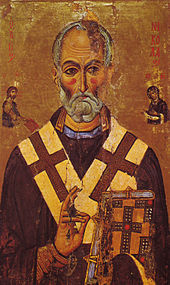 Saint Nicholas of Myra is the primary inspiration for the Christian figure of Sinterklaas. He was a 4th century Greek Christian bishop of Myra (now Demre) in Lycia, a province of the Byzantine Anatolia, now in Turkey. Nicholas was famous for his generous gifts to the poor, in particular presenting the three impoverished daughters of a pious Christian with dowries so that they would not have to becomeprostitutes. He was very religious from an early age and devoted his life entirely to Christianity. In continental Europe (more precisely the Netherlands, Belgium, Austria and Germany) he is usually portrayed as a bearded bishop in canonical robes. In 1087, the Italian city of Bari, wanting to enter the profitable pilgrimage industry of the times, mounted an expedition to locate the tomb of the Christian Saint and procure his remains. The reliquary of St. Nicholas was conquered by Italian sailors and the spoils, including his relics, taken to Bari where they are kept to this day. A basilicawas constructed the same year to store the loot and the area became a pilgrimage site for the devout, thus justifying the economic cost of the expedition. Saint Nicholas was later claimed as a patron saint of many diverse groups, from archers, sailors, and children to pawnbrokers. He is also the patron saint of both Amsterdam and Moscow.
Chimney tradition
The tradition of Santa Claus entering dwellings through the chimney is shared by many European seasonal gift-givers. In pre-Christian Norse tradition, Odin would often enter through chimneys and fireholes on the solstice. In the Italian Befana tradition, the gift-giving witch is perpetually covered with soot from her trips down the chimneys of children's homes. In the tale of Saint Nicholas, the saint tossed coins through a window, and, in a later version of the tale, down a chimney when he finds the window locked. In Dutch artist Jan Steen's painting, The Feast of Saint Nicholas, adults and toddlers are glancing up a chimney with amazement on their faces while other children play with their toys. The hearth was held sacred in primitive belief as a source of beneficence, and popular belief had elves and fairies bringing gifts to the house through this portal. Santa's entrance into homes on Christmas Eve via the chimney was made part of American tradition through Moore's A Visit from Saint Nicholas where the author described him as an elf
.
.
Christmas Eve rituals
 In the United States and Canada, children traditionally leave Santa a glass of milk and a plate of cookies; in Britain and Australia, he is
sometimes given sherry or beer, and mince pies instead. In Sweden and Norway, children leave rice porridge. In Ireland it is popular to give him Guinness or milk, along with Christmas pudding or mince pies.
British, Australian, Irish, Canadian and American children also leave a carrot for Santa's reindeer, and were traditionally told that if they are not good all year round, that they will receive a lump of coal in their stockings, although this practice is now considered archaic. Children following the Dutch custom for sinterklaas will "put out their shoe"—that is, leave hay and a carrot for his horse in a shoe before going to bed—sometimes weeks before the sinterklaas avond. The next morning they will find the hay and carrot replaced by a gift; often, this is a marzipan figurine. Naughty children were once told that they would be left a roe (a bundle of sticks) instead of sweets, but this practice has been discontinued.
Santa Claus's home traditionally includes a residence and a workshop where he creates—often with the aid of elves or other supernatural beings—the gifts he delivers to good children at Christmas. Some stories and legends include a village, inhabited by his helpers, surrounding his home and shop.

